

When you search for “documents for renting a property Trinidad,” it helps to know that the exact application requirements can vary by rental. This guide explains what you can prepare, how to organize sensitive records, and how Cornerstone’s Tenant Application Form and rental listings fit into your search.
Key Takeaways
- There is no single checklist for every rental. Treat examples of documents for renting a property Trinidad landlords may request as preparation guidance, then follow the instructions for the specific property.
- Keep possible records organized by identity, address, income, and references. Submit only the information requested for your application.
- Before sharing personal documents, make sure you know which rental the application concerns, who will receive the information, and how to submit it.
- Cornerstone’s Tenant Application Form supports the application process. Preparing your paperwork helps you present your details clearly, but it does not guarantee an application outcome.
Documents for Renting Property in Trinidad
Start by preparing information that may be requested for a rental application, but use the instructions for the specific property as your checklist. A landlord may ask about your identity, contact details, address, income, or references. These are practical examples, not a universal legal list. Gathering likely records in advance can help you respond clearly, while the property’s application requirements determine what you need to submit.
Which documents are commonly requested for a rental application?
Keep your current contact details handy and prepare examples of documents you can provide if the application requests them:
- Identity: Government-issued photo identification, such as a national ID card, driver’s permit, or passport.
- Income: A job letter, payslip, or other evidence that explains your income. Suitable records can depend on your work arrangement.
- Address and references: Proof of your current address or a reference’s contact details, if requested.
Check the application instructions before sending anything. For example, if income evidence is requested, provide the type of record specified rather than attaching several unrelated financial documents. Keep the information consistent with the details on your application.
Why can rental document requirements differ?
Application requirements can differ between rentals. One application may ask for income evidence, while another may request a reference or proof of address. The type of evidence accepted can also vary, so a general checklist is a starting point, not a substitute for the instructions for the property you are applying for.
Keep the application stage separate from the agreement stage. If your application proceeds, review questions to ask before renting a house and read the written terms carefully before signing. This overview of a residential lease agreement explains how rental agreements set out obligations between landlords and tenants.
Rental application documents: prepare identity, address, income, and references
Once you know what the application asks for, make each document easy to identify and review. Group files by purpose, use clear file names, and keep a private copy of what you submit. Before sending, confirm that each file opens, is readable, and matches the information on your application. These simple checks can reduce avoidable follow-up.
- Sort: Group related records so you can find each attachment quickly.
- Name: Use plain file names that identify the document without putting extra personal details in the title.
- Review: Check names and dates for accuracy. Where possible, leave out pages that are unrelated to the request.
- Keep: Save a copy of the completed form and submitted files in a private place for your records.
What income documents might employed or self-employed renters prepare?
The right income evidence depends on your work arrangement and the application instructions. An employed applicant and a self-employed applicant may be asked for different information, so do not assume one document type will suit everyone. Read the requirements before sharing financial records, and provide only what is requested. If an instruction is unclear, use the stated application route to clarify what information is needed.
Should you prepare references and proof of address?
Have current details ready if the application requests them, and let a reference know before sharing their contact information. Review any proof of address for details that are not relevant to the request. If you can provide a more limited copy that still meets the stated requirement, avoid sharing unrelated personal information. For general context on tenant and landlord matters in Trinidad and Tobago, read the Legal Aid and Advisory Authority’s tenant rights guidance.
When your documents are organized, use them to complete the application for a rental that suits you. Explore Cornerstone’s rental listings to browse available options.
Before sending rental documents, protect your information and clarify the request
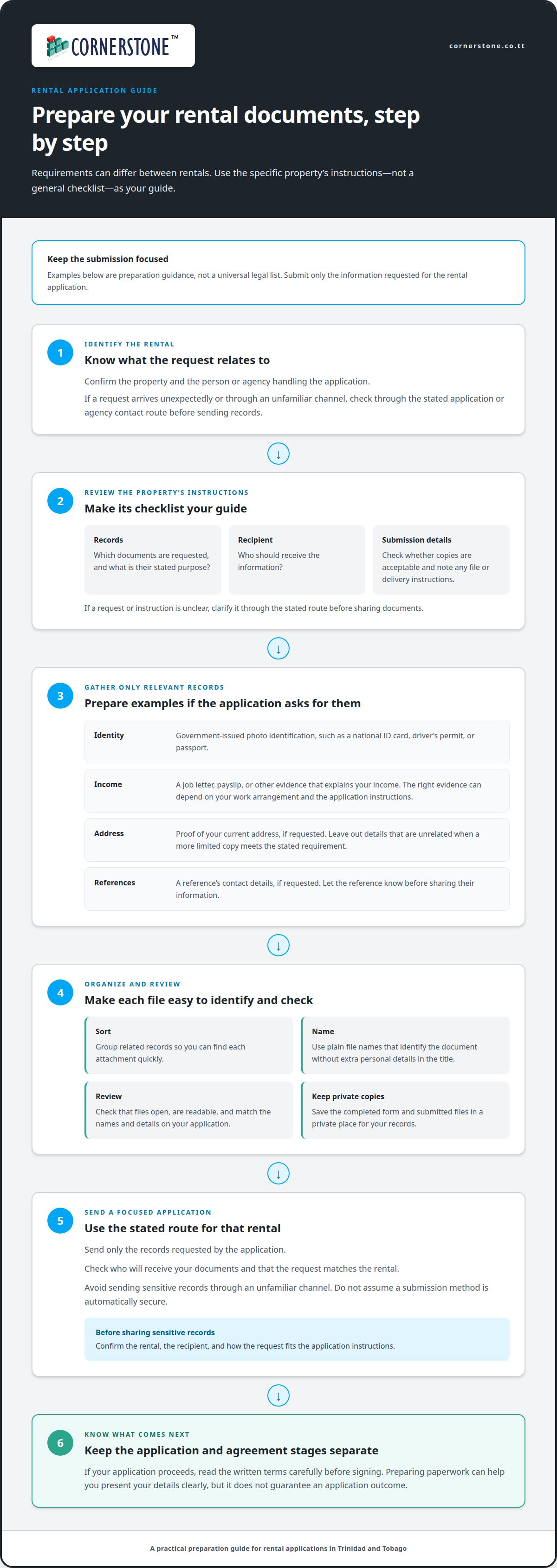
Before sharing identity or financial records, make sure you understand which rental the application concerns and what information it requests. This sequence can help you keep your submission focused:
- Identify the rental. Confirm that the property and the person or agency handling the application are clear to you.
- Review the checklist. Note which records are required, the purpose stated for them, and who should receive them.
- Send only what is requested. Follow the application or agency contact route provided for that rental, rather than sending sensitive records through an unfamiliar channel.
Before sharing sensitive records, check who will receive them and whether the request matches the rental application. If something does not match the application instructions, pause and clarify it through the stated route before sending documents.
When should you share personal or financial documents?
The timing depends on the rental’s application process. A viewing is not always a required step before applying, so focus on understanding which property the request relates to and how the documents fit its process. If a request arrives unexpectedly or through a channel you do not recognize, use the stated agency or application contact route for guidance before sending records. Do not assume that any particular submission method is automatically secure.
What should you clarify before completing an application?
Check which documents are requested, whether copies are acceptable, and whether there are instructions about file type or delivery method. If other people will live in the rental, follow the form’s instructions about whose details or records to include. Do not assume every intended occupant needs to provide the same information. If the purpose of a requested document is unclear, clarify how it will be used and who should receive it.
To browse rental listings and find an application for a suitable option, explore Cornerstone’s rental listings.
After preparing your documents: complete the rental application and plan next steps
Put the information requested for the rental together with your completed application, then review the form and attachments before submitting them. A clear application helps present your details, but it does not guarantee approval or determine the outcome. Keep a private copy so you can refer to what you provided if you need to follow up.
How can you keep your rental application organized?
Name files clearly so each attachment is easy to match to the relevant part of your application. Confirm that files open, details are legible, and you have completed the requested fields and attached the specified records. Store your copies somewhere private, especially if they contain personal or financial information.
What happens after you submit a tenant application?
The information you provide may be considered during prospective tenant screening. The next steps depend on the rental’s application process. A complete submission is not a promise of approval or a decision by a particular date. Keep your contact details current and use the stated application route if you need to follow up.
With your paperwork in order, you can focus on finding a rental that suits your needs. Review the available options and take the time you need to decide which ones fit your plans.
If you are ready to look, explore Cornerstone’s rental listings.
Take the next step towards a rental that suits you
Choosing a rental is a personal decision. Consider what fits your needs and plans, then use the specific property’s requirements to guide your application. A well-prepared application can help you share your information clearly, without committing you to a rental before you have reviewed its details.
Cornerstone is a family-run real estate company in operation since 2004, helping clients rent, buy, sell, and manage property in Trinidad and Tobago. Its Tenant Application Form supports the rental application process, and its listings let you browse available properties at your own pace.
When you are ready, explore Cornerstone rental listings and submit the Tenant Application Form for a rental you wish to pursue.
Frequently Asked Questions
What documents do you need to rent a property in Trinidad?
There is no single document list for every rental. Documents for renting a property Trinidad landlords may request include identification, income evidence, proof of address, or references. One application might ask for identification and one type of income evidence, while another may request different details. Follow the instructions for the property you are applying for rather than treating examples as legal requirements.
Can I apply to rent a property in Trinidad without a job letter?
A job letter is one possible way to show income, but it is not the only type of information an application may request. What is suitable can depend on your circumstances and the rental’s application process. Read the instructions before preparing another record as a substitute, and do not assume it will be accepted in place of a job letter. Submit only the information requested.
Do self-employed renters need to provide bank statements?
Not necessarily. A rental application may ask a self-employed applicant for income evidence, and bank statements are one possible example, but they are not automatically required for every rental. Check the application instructions before sharing statements or business records. If the request is unclear, clarify which information is needed and whether the document should cover a particular period instead of sending extra financial details.
Should I send my rental documents before viewing a property?
It depends on the rental’s application process. A viewing is not always a required first step, but you can pause before sending sensitive records if you are unsure about the request. Check which documents are needed, who will receive them, and how to submit them. Consider the information provided before sharing, since no submission channel can guarantee privacy.
Are two forms of identification required to rent in Trinidad and Tobago?
Not for every property. One local rental guide lists two forms of identification, but that example is not a rule for every landlord or application. Check the instructions for the rental before gathering or sending identification. If two forms are requested, confirm which types are acceptable and whether copies or another format are needed.