
Buying land does not automatically mean you can use or develop it as planned. In Trinidad and Tobago, development generally requires planning permission, including building or engineering work, subdivision, and a material change in land use. A town and country planning approval check before buying land in Trinidad can help establish what is allowed before you commit.
A seller’s approval letter or a residential-use designation may not cover your intended plans. The specific parcel, proposed use, approved plans, and any attached conditions all matter.
This guide explains when planning permission may be needed, how to review planning records and stamped plans, and how planning permission differs from a building permit before construction begins.
Key Takeaways
- Learn which proposed land uses, building work, and subdivisions may need planning permission, and why a parcel’s planning history matters.
- See what to look for in the actual planning decision, stamped plans, and any conditions attached to an approval.
- Understand what a Status of Land letter can tell you about permitted use and bona fide status, and what it does not establish on its own.
- Separate planning permission from a building permit so you can understand the distinct approvals involved before construction begins.
1. When is planning permission needed?
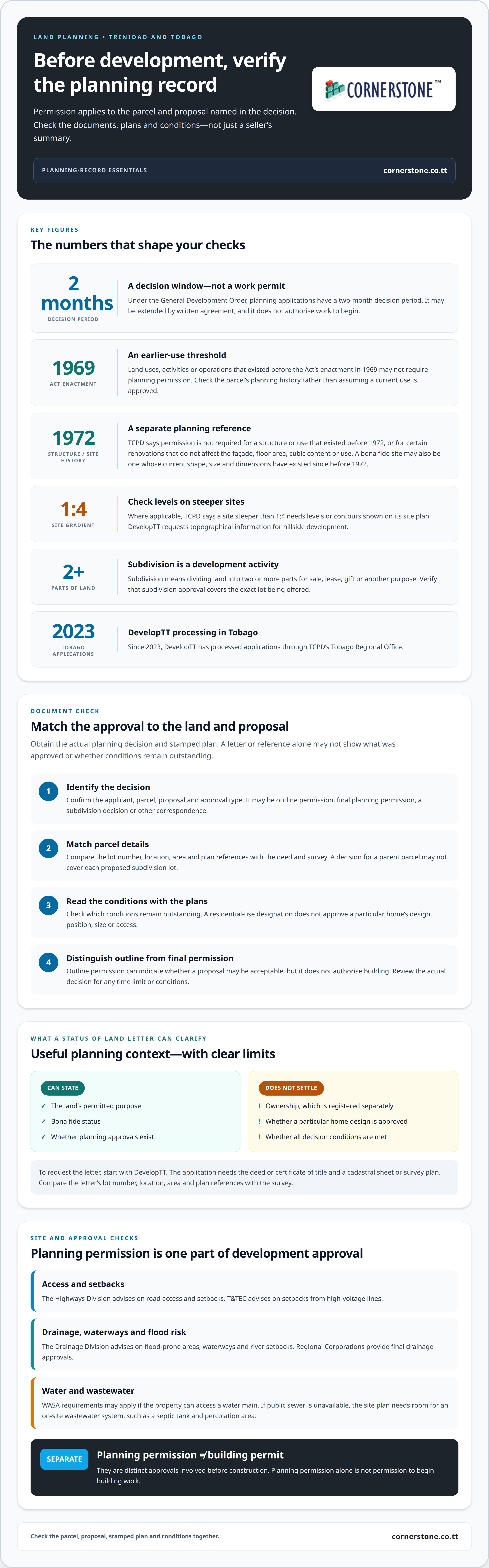
In Trinidad and Tobago, the Town and Country Planning Act, Chapter 35:01, treats building, engineering, mining, other operations on land, material changes in land or building use, and subdivision as development. Subdividing means dividing land into two or more parts for sale, lease, gift, or another purpose, according to the Town and Country Planning Division. A new activity or a change from the land’s permitted use may therefore need planning permission. The Act’s permitted development provisions and the parcel’s planning history help determine what can proceed.
Some existing uses may be treated differently. Planning permission is not required for land uses, activities, or operations that existed before the Act’s enactment in 1969. TCPD also says permission is not required for a structure or use that existed before 1972, or for certain renovations that do not affect the façade, floor area, cubic content, or use. A Status of Land letter can help clarify the parcel’s permitted purpose and planning history.
To request a Status of Land letter, start with DevelopTT, Trinidad and Tobago’s online development-permitting portal. You will need the deed or certificate of title and a cadastral sheet or survey plan. For parcel-level land-use information, compare the letter’s lot number, location, area, and plan references with the survey. General planning policy describes intended land use, but it does not approve a particular house design or subdivision.
Under the General Development Order, planning applications have a two-month decision period, which may be extended by written agreement. This is a period for a decision, not permission to begin work. Start the relevant request or application through DevelopTT, and keep its correspondence reference with the parcel documents.
Planning permission is only one part of development approval. The Highways Division advises on road access and setbacks. The Drainage Division advises on flood-prone areas, waterways, and river setbacks, while Regional Corporations provide final drainage approvals. T&TEC advises on setbacks from high-voltage lines, and WASA requirements may apply if the property can access a water main. Consider these matters in relation to the specific parcel and proposed work.
2. Checking planning decisions, stamped plans and conditions
For a planning approval check, obtain the actual decision and stamped plan, not just a seller’s summary or letter. Confirm that the decision identifies the correct applicant, parcel, proposal, and approval type. It may be an outline permission, final planning permission, subdivision decision, or other correspondence. Match the lot number, location, area, and plan references against the deed and survey. A decision for a parent parcel may not cover each proposed subdivision lot.
Read every condition alongside the approved plans. Residential-use permission does not automatically approve a particular home’s design, position, size, or access. Check whether the decision grants outline permission: this can indicate whether a proposal may be acceptable, but does not authorise building. Final planning permission and approval conditions are separate steps. In Trinidad and Tobago, reasons must be given in writing when permission is refused or granted with conditions.
Site features can shape what plans and supporting details are needed. TCPD says that, where applicable, a site steeper than 1:4 needs levels or contours shown on its site plan. For hillside development, DevelopTT requests topographical information. A survey plan for a planning application must be signed by a licensed land surveyor. These details help relate proposed building locations to the site’s actual shape.
Check whether the site plan addresses drainage, watercourses, river setbacks, and flood-prone areas. The Drainage Division advises on these matters, while Regional Corporations provide final drainage approvals. If high-voltage lines cross or run beside the land, T&TEC advises on setbacks. If public sewer is unavailable, the site plan needs room for an on-site wastewater system, such as a septic tank and percolation area.
For land in Tobago, DevelopTT has processed applications through TCPD’s Tobago Regional Office since 2023. Keep the decision and stamped plan together, and note which conditions remain outstanding. A planning approval reference alone does not show that every condition or building and servicing requirement has been met.
3. Confirming a plot’s planning permission and bona fide status
A Status of Land letter from the Town and Country Planning Division can state the land’s permitted purpose, bona fide status, and whether planning approvals exist. In Trinidad and Tobago, a bona fide site is one granted subdivision permission, or one whose current shape, size, and dimensions have existed since before 1972. Treat this status as a planning detail, not proof of ownership: land ownership is registered separately.
A town and country planning approval check before buying land in Trinidad and Tobago should confirm that subdivision approval covers the exact lot being sold. Compare the decision and stamped layout with the lot number, location, area, and survey plan. A letter for a parent parcel does not necessarily establish approval for each proposed lot. The Town and Country Planning Division defines subdivision as dividing land into two or more parts, whether for sale, lease, gift, or another purpose.
Planning permission concerns the land and proposal named in the decision, while ownership is registered separately. Review the actual decision and its conditions rather than assuming they apply to a changed scheme. For a town and country planning approval check before buying land in Trinidad and Tobago, look for any time limit or conditions in the decision. A Status of Land letter alone does not settle those details.
Identify whether the document records outline permission, final planning permission, subdivision approval, or other correspondence. Outline permission can indicate whether a proposal may be acceptable, but does not authorise building. A residential-use statement does not approve a particular home design, location, or size. If a Status of Land letter appears factually incorrect, identify the exact statement and provide the Town and Country Planning Division with relevant title, survey, or approval references. Include the complete letter in your land purchase review with your attorney and lender.
4. Planning permission versus a building permit
In Trinidad and Tobago, planning permission and a building permit are separate approvals from different authorities. The Town and Country Planning Division considers the proposed development and its land-use implications. The relevant Municipal Corporation issues building permits. Planning permission alone does not authorise construction. Both approvals are needed before construction begins.
Final planning permission starts the building approval process, but its conditions must be met before work begins. The Division sends copies of plans to the relevant Municipal Corporation to review building health and safety requirements. A planning decision and Council-approved building plans serve different purposes. For example, permission for a proposed house does not, by itself, mean its construction plans have Council approval.
Before building, establish which plans received approval and whether the proposed work matches them. The Municipal Corporations Act, Chapter 25:04, makes it an offence to erect or alter a building without Council-approved plans, or to build contrary to those plans. A planning approval reference cannot replace the building permit or approval of plans by the Corporation.
Keep the documents distinct as you follow the approval process. The planning decision addresses the proposed development; the building permit relates to the Corporation’s building approval. Conditions attached to planning permission may also affect when work can start. If the proposal changes after approval, such as through a different building layout, check which approved plans and conditions apply before proceeding.
When buying land, this distinction helps you avoid treating permission for a land use as approval to construct a particular building. Review the planning decision, relevant stamped plans, and the Municipal Corporation’s building approval as separate documents. Begin construction only after planning permission and the required building approval are in place and applicable conditions are met.
Cornerstone
Cornerstone can help you consider a land purchase alongside your plans for the property. If you are deciding whether a parcel suits your goals, a property market opinion can provide context about the market. Cornerstone also assists with property sales and rentals for land you intend to buy, sell, or rent. If you already own property, management may be relevant to your next steps.
Planning permission, approved plans, and building permits are separate from these real estate decisions. Keep the planning documents and conditions in view as you consider whether the land meets your needs. A market opinion is not planning approval or a licensed valuation.
To talk through your property plans, contact Cornerstone.
Make your land decision with a clear plan
A town and country planning approval check before buying land in Trinidad and Tobago is most useful when it reflects what you want the property to do for you. Set out your intended use and base your purchase decision on the documents and terms that apply to that specific parcel. If approval is assumed rather than documented, discuss suitable contractual protections with your attorney before paying a deposit.
Cornerstone’s team can help you consider the property’s market context alongside your plans. Its property market opinions, sales, and rentals support different property decisions, but do not replace planning approval or legal advice. The next step depends on whether you are considering buying, selling, or renting, and on how the land fits your goals.
Take your time, and choose a next step that suits your plans. Contact Cornerstone about your land to talk through your property needs.
Frequently Asked Questions
When is planning permission needed?
Planning permission is generally needed when proposed development requires approval under Trinidad and Tobago’s planning rules. If a planned use or project does not clearly fit the land’s planning history, seek a decision before relying on an assumption. An outline application can help establish whether a proposal may be acceptable before you invest in detailed design, but it does not authorise construction.
What happens if I have purchased property in an unauthorized sub-division?
Start by gathering the purchase documents and planning records that refer to the subdivision. Ask the Town and Country Planning Division to clarify the parcel’s planning position, then share the information with an attorney dealing in land matters. Before making further commitments based on assumed approval, discuss contractual protections with your attorney. Planning status and the legal or financial position of your purchase are separate matters.
What is defined as development?
Under Section 8 of the Town and Country Planning Act, Chapter 35:01, development includes building, engineering, mining, other operations on land, material changes in land or building use, and subdivision. The practical question is whether the proposed activity falls within one of these categories. For example, changing a property’s use or dividing a parcel may raise planning requirements, even without a new house design.
Where can I get information about my land?
For planning information, contact the Town and Country Planning Division or use DevelopTT. Ownership records are a separate source: the Ministry of Legal Affairs holds land records under the applicable title or deed system. An attorney dealing in land matters can examine those records for ownership issues and encumbrances. Use planning information to understand land use, and ownership records to assess the legal interest being purchased.
What documents and parcel details are needed to verify planning approval in Trinidad and Tobago?
Have the relevant planning decision and stamped plan ready, along with the deed or certificate of title and survey plan. Check whether the approval identifies the applicant, proposal, land covered, and any conditions. If a document refers to a different lot or plan, resolve the mismatch before relying on it. A survey plan used for an application must be signed by a licensed land surveyor.
How do I request a planning status or certificate of approval from Trinidad and Tobago’s TCPD?
Use DevelopTT to request planning status, supplying the required title document and cadastral sheet or survey plan. If you already have a Status of Land letter and need clarification, send TCPD its correspondence reference and relevant records. For an existing approval, request or review the actual decision document rather than treating a status letter as a certificate of approval. Keep the response with your purchase records.