


The right agent for your Trinidad property matches your goal, communicates clearly and understands the local market. As you decide how to choose a real estate agent in Trinidad, consider registration too: under the Real Estate Agents Act, 2020, registration is valid for three years unless cancelled, suspended or revoked.
You need more than someone who can arrange viewings or advertise a property; look for an agent who understands whether you’re selling, buying, renting or managing, explains the steps in plain language and keeps you informed.
This guide covers how to assess an agent’s experience, property specialisation, client support and local knowledge, as well as their approach to marketing and comparing properties.
Key Takeaways
- Match an agent’s experience to your property type and the decision you need to make.
- Look for a specialisation and service area that fit your plans, whether you’re buying, selling, renting or managing property.
- Pay attention to how clearly an agent explains the process and keeps you informed through each stage.
- Use neighbourhood knowledge and comparable sales to understand how an agent arrives at pricing advice.
1. Experience across residential, land and commercial properties
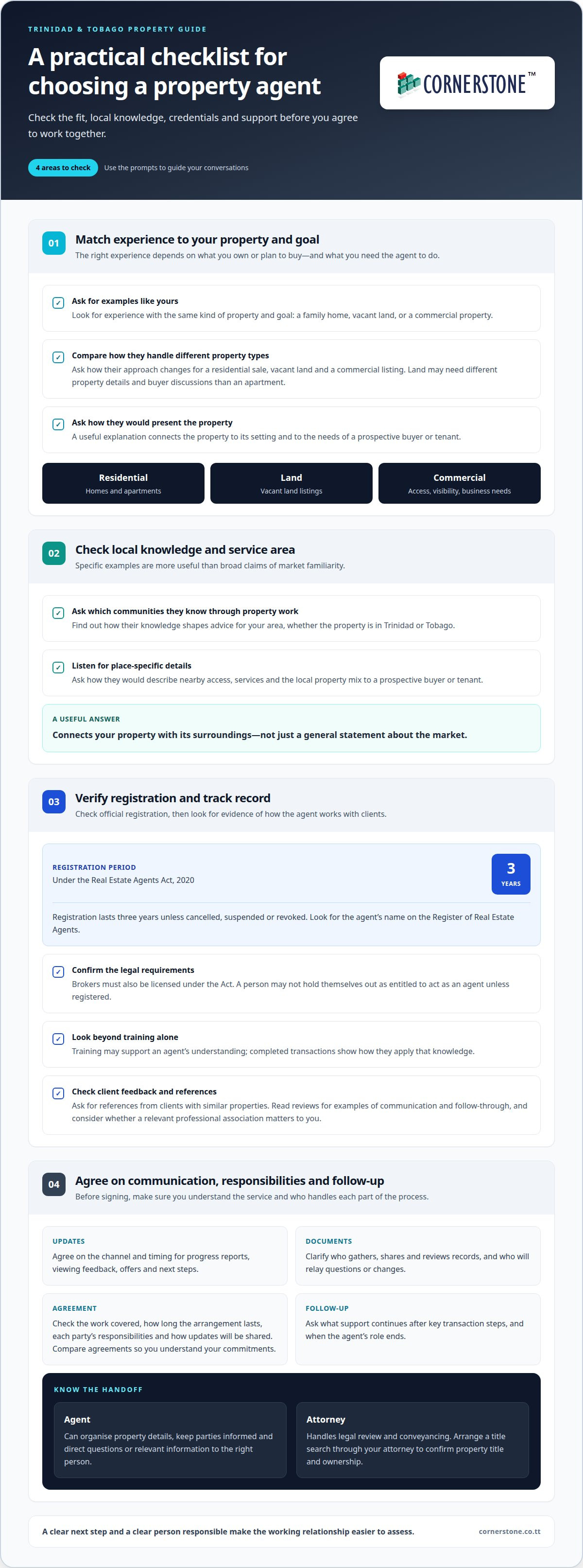
Look for an agent whose experience matches your property and goal. A buyer seeking a family home needs different guidance from a landowner preparing vacant land for sale. Commercial properties bring their own questions about access, visibility and business needs. Ask for examples of similar properties and what the agent handled. Their answers can help you judge whether their experience fits your situation.
Local knowledge should be specific. An agent familiar with an area can explain how nearby property types, road access and amenities may shape buyer or tenant interest. Ask how they would present your property and its surroundings to a prospective buyer or tenant. A useful answer connects the property to its setting rather than relying on broad claims about the market.
Training and experience can both matter. Training may support an agent’s understanding, while completed transactions show how they apply that knowledge. Ask how their approach differs for a residential sale, vacant land and a commercial listing. A land sale, for example, may require different property details and buyer discussions from an apartment sale.
To verify registration, look for the agent’s name on the Register of Real Estate Agents. Under the Real Estate Agents Act, 2020, registration lasts three years unless cancelled, suspended or revoked. Brokers must also be licensed under the Act, and a person may not hold themselves out as entitled to act as an agent unless registered.
Ask for references from clients with similar properties, then read reviews for examples of communication and follow-through. You may also want to check whether an agent belongs to a relevant professional association. Before signing an agreement, make sure it explains the work, how long the arrangement lasts, each party’s responsibilities and how updates will be shared. Compare those details across agreements so you understand the service and your commitments.
Using an unregistered person risks dealing with someone not entitled to act as an agent. For a purchase or sale, clarify the steps and records involved, including which documents your attorney prepares or reviews. These checks make choosing an agent in Trinidad more practical.
2. Agent specialisations and service areas
An agent’s property specialisation should match your next decision. A buyer looking for a family home may need different guidance from an owner selling vacant land. Commercial property brings other considerations, such as access, visibility and the needs of business tenants. Ask for an example involving a similar property, then listen for a clear explanation of the likely steps, from preparing the listing to handling enquiries.
Geographic knowledge matters too. An agent working across Trinidad may know one set of neighbourhoods well, while Tobago presents different local conditions and buyer interests. Ask which communities they know through direct property work, and how that knowledge shapes their advice. For example, discuss how they would describe your area’s access, nearby services and property mix to a prospective buyer or tenant. A clear, place-specific answer is more useful than a broad claim of island-wide familiarity.
Support should continue after an offer or tenancy begins. Before choosing an agent, ask what communication to expect at each stage. For a sale, clarify who will update you about viewing feedback, offers and next steps. For a rental, ask how the agent handles applicant enquiries and keeps the process moving. The answers can show whether the agent’s approach suits your needs as well as the property.
Customer service is practical: clear replies, agreed ways to communicate and explanations you can follow. At an initial meeting, describe your goal and ask the agent to outline the next steps in plain language. Notice whether they listen, address your concerns and explain what information they need from you. If you’re preparing to sell, you can explore property sales support as a next step. Choose a specialist whose service area and communication style suit your plans, whether the property is in Trinidad or Tobago.
3. Client support during and after a transaction
Useful support means knowing what happens next at each stage. During a sale, an agent can arrange viewings, share buyer feedback and explain offers clearly. As a buyer, you may need help coordinating property information and keeping communication moving. Ask who will update you, how updates will arrive and what happens after an offer is accepted.
To confirm a property’s title and ownership, arrange a title search through your attorney. The agent can organise property details and keep the parties informed, but legal review and conveyancing are the attorney’s role. An agent’s knowledge of a listing does not replace a legal check of ownership.
Before proceeding, agree on how communication will work. Clarify who will share documents, relay questions and report changes. If a buyer asks about boundaries or access, the agent can help direct the question and relevant property information to the right person. Clear handoffs reduce confusion between the buyer, seller, agent and attorney.
Support also matters after a sale is completed or a tenancy begins. Ask what follow-up the agent provides, such as sharing final updates or directing outstanding property questions to the appropriate person. For a rental, clarify how tenant communications and move-in arrangements are handled. For a sale, confirm when the agent’s transaction role ends.
Use these points to assess the working relationship:
- Updates: agree on the channel and timing for progress reports.
- Documents: clarify who gathers, shares and reviews each record.
- Questions: identify who handles buyer, seller or tenant concerns.
- Follow-up: confirm what support continues after the key transaction steps.
You should leave each conversation knowing the next step and who is responsible for it. That practical clarity is a useful sign of attentive service.
An agent can also advise clients about attorney’s fees, valuator’s fees, stamp duty and mortgage release costs, helping them understand expenses alongside the practical steps.
4. Neighbourhood knowledge and comparable sales
Comparable sales can show how buyers have responded to properties with similar features. An agent can compare location, size, condition, layout and access, then explain which similarities matter most. For example, a home near a main road may differ from a similar home on a quieter street. Ask how the agent accounts for those differences when discussing your property’s position in the market.
Local knowledge adds context when comparing properties. An agent familiar with the area can explain how access, nearby services, property upkeep and demand may shape buyer interest. Ask why a comparison is relevant and where the properties differ. Specific reasoning helps you judge whether the evidence reflects your property’s setting and features.
A useful track record includes more than completed transactions. Ask how the agent handled a property that drew different levels of interest, what feedback came from viewings and how that feedback shaped the next steps. These examples can show how the agent uses market information in practice. They cannot predict the result for your property, but they can help you assess the agent’s judgement.
To compare agents’ experience, local knowledge and track records, ask each to explain a similar completed sale, the evidence they used and the outcome. Compare the quality of their reasoning, not just the number of transactions they mention. Ask how they account for differences in condition, access or land features. This helps you judge whether their knowledge fits your property.
If you’re preparing to sell, discuss your property’s local market position and the comparable sales that may inform your next steps.
Comparing your property with similar properties that have sold is one way to inform a discussion about price. Ask how the agent chose relevant comparisons and interpreted the results. Find out which similarities supported the advice, which differences limited the comparison and how the evidence shaped the suggested position, rather than relying on a headline figure alone.
Cornerstone
Cornerstone can help you apply these checks to your property plans in Trinidad and Tobago. Its property sales service supports people buying or selling, while property rentals and management suit owners focused on finding tenants or overseeing property. For pricing guidance, Cornerstone provides a property market opinion, which provides market context, not a licensed valuation.
Clear communication and evidence-based guidance can help you assess your options and decide what support fits your needs. Share your property goals and the questions you’re weighing, whether they concern experience, service or local knowledge. Contact Cornerstone to discuss your property plans.
Take the next step with a clear plan
Choosing an agent also means deciding what kind of working relationship will help you move forward. Before you begin, write down your main goal, the questions you still have and the updates that would help you stay informed. This gives you a practical starting point for a conversation and helps you explain what matters most.
If you’re weighing how to choose a real estate agent in Trinidad, focus on whether the agent’s approach fits your plans and property. Cornerstone’s team works with local realtors and supports people exploring property sales, rentals or a property market opinion. Bring your questions and discuss the guidance you need for your next decision.
You don’t need to have every detail settled before starting a conversation. A useful first discussion can help you set priorities and understand your options. Contact Cornerstone to discuss your needs, and take the next step at a pace that feels right for you.
Frequently Asked Questions
What should I ask a real estate agent before hiring them in Trinidad?
Ask how the agent plans to present your property, handle enquiries and share offers or feedback. If you’re selling, ask how the property will be marketed and who will coordinate viewings. If you’re buying, explain what matters most, such as outdoor space or room for a home office, and ask how the agent will help you explore suitable options. Their answers can help you judge whether the working arrangement fits your needs.
Should I choose an agent who specializes in my area or property type in Trinidad?
Prioritise the property type and local knowledge that matter most to your decision. Experience with commercial property can help an agent discuss business-related features, while residential experience may be more relevant to homebuyer priorities. Ask how the agent develops local context and explains the property’s appeal and specific surroundings.
How much commission do real estate agents charge in Trinidad and Tobago, and who pays it?
The commission is 3% of the purchase price for a sale, one month’s rent for a rental of one year or longer, and 10% of the total rent for a fixed-term rental under one year. It is paid when the transaction is completed.