
Residential property prices in Trinidad are expected to remain relatively stable through 2026, but that doesn’t mean every home or area is moving in the same way. A property market opinion in Trinidad needs to consider local demand, location and the features buyers value. The Association of Real Estate Agents said demand for middle-income housing had held up and was increasing, while this article explains how property features, wider market conditions and the energy sector can influence demand, helping you understand the market whether you’re considering buying, selling, renting or investing.
Key Takeaways
- Look beyond a home’s size and condition: location, layout and features buyers value also shape its appeal.
- Residential prices are expected to remain relatively stable through 2026, while demand can vary between market segments.
- Consider how energy-sector activity may affect housing demand and rental interest in different parts of Trinidad and Tobago.
- Compare local demand and property features when weighing where to buy, sell or rent, rather than assuming one area suits everyone.
What Affects Property Values?
A home’s value depends on its location, land, size, condition, layout and the features buyers seek. A property with convenient access and well-kept shared spaces may appeal differently from a similar home that needs repairs. A property market opinion in Trinidad considers these details alongside comparable properties in the local market.
History shows why timing matters. Trinidad house prices rose by over 400% between 1991 and 2006, then fell by 20% before beginning to rise again, as of late 2014. Those past movements describe earlier periods, not a guarantee of what an individual property will do today.
How do property prices in Trinidad compare with Tobago and other Caribbean markets? There is no single comparison that applies to every home. Location, property type, size, condition and amenities all shape value, so compare similar homes in similar settings rather than treating Trinidad, Tobago or the wider Caribbean as one market.
Residential land also varies by setting. Ready-to-build land in gated developments outside West Trinidad can range from 5,000 to 10,000 square feet. Established neighbourhood plots across Trinidad can sometimes average more than 7,000 square feet. Access, services, terrain and development restrictions affect how useful a plot is.
A home’s condition matters. An older property may offer more interior space, but needed repairs can affect buyer interest. When assessing it, consider the work involved alongside the location, layout and usable land.
What rules apply to foreign buyers purchasing property in Trinidad and Tobago? The Foreign Investment Act governs certain property purchases by non-citizens. Eligibility can depend on the buyer and property, so review the applicable rules and title as part of the transaction.
What are current mortgage interest rates, down-payment requirements and loan terms in Trinidad and Tobago? They depend on the lender, borrower and property. Mortgage pre-approval can help establish borrowing eligibility before a buyer makes an offer.
What taxes, fees and legal costs apply when buying or selling property in Trinidad and Tobago? A transaction can involve taxes, as well as legal and registration charges. The amounts depend on the property and transaction, so include them when assessing the overall purchase.
Buying typically involves agreeing on terms, arranging a title search, completing conveyancing and registering the transfer. Risks such as flooding, crime and insurance availability can also affect a property’s suitability and ongoing ownership needs.
Trinidad residential property market conditions
Trinidad’s residential market is expected to remain relatively stable through 2026. That outlook describes the wider market, not every home or neighbourhood. A property’s position still depends on its location, condition, type and the buyers or tenants seeking it. For you, stability means looking beyond broad headlines and weighing the specific features of a property.
The Association of Real Estate Agents said demand for middle-income housing had held up and was increasing. Buyers seeking practical homes continue to shape interest in this segment. Sellers can highlight a property’s useful features and condition when presenting it. This gives a clearer view of how a home may fit current demand, rather than assuming all residential properties move alike.
Available homes differ by size and setting. In West Trinidad, small apartments in older complexes or buildings may measure less than 1,000 square feet. Three-bedroom apartments and townhouses in established developments such as West Hills and Victoria Keyes offer another option. These examples show why a market comparison should match the property type, size and location.
Family homes create a different comparison. In East and Central Trinidad and Santa Cruz, homes can average more than 2,500 square feet. A household considering these areas can compare space and location with its needs. The result is a more relevant shortlist than one based on the general label “residential market.”
The market’s earlier cycle also adds context. After the downturn, property deals were available up to 2011-12. That period is historical, so it should not be treated as a guide to today’s conditions. Instead, compare current properties using similar locations and types, then consider how their condition and features affect demand.
If you’re selling or considering a purchase, a property market opinion can help frame the home against local conditions. It supports a more informed decision alongside the property’s particular features.
Energy-sector effects on property demand
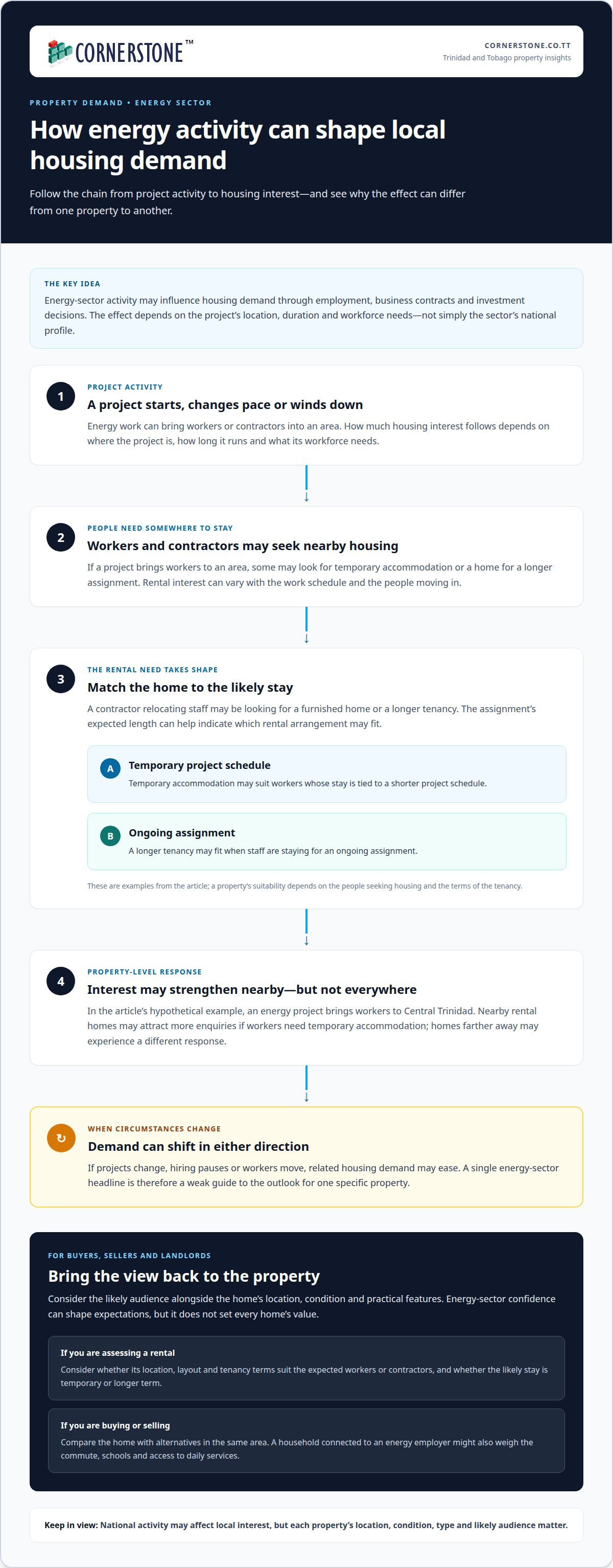
Energy-sector activity can influence housing demand through employment, business contracts and investment decisions. When a project brings workers or contractors to an area, some may seek nearby housing. If activity slows, that demand can ease. The effect depends on the project’s location, duration and workforce needs, not simply the sector’s national profile.
Consider a hypothetical energy project that brings workers to Central Trinidad. If they need temporary accommodation, nearby rental homes may attract more enquiries. Owners can assess whether their property’s location, layout and tenancy terms suit that group. Suitable rentals may see stronger interest, while homes farther away may experience a different response.
Rental demand may also come from service firms supporting energy operations. For example, a contractor relocating staff may seek a furnished home or a longer tenancy. A landlord considering this audience should account for the likely stay and the home’s practical features. A short project schedule may support temporary demand, while an ongoing assignment may suit a longer rental.
For buyers and sellers, energy-sector confidence can shape expectations, but it does not set every home’s value. A household connected to an energy employer might weigh the commute, schools and access to daily services. Sellers can present relevant features clearly, while buyers compare each property with alternatives in the same area.
Demand can shift if projects change, hiring pauses or workers move. That makes a single energy headline a weak guide to a specific property. Consider its location, condition and likely audience together. For a rental, assess whether the home suits the expected tenancy. For a sale, compare similar nearby properties and their features.
For example, two homes in Central Trinidad may respond differently to the same local employment change. One may suit a worker seeking a convenient rental; the other may appeal to a household planning to live there long term. Treat energy activity as one factor, then assess each property and its potential audience separately.
Which areas in Trinidad and Tobago have the strongest demand for homes and rentals?
Demand varies by property type, so no single area leads every part of Trinidad and Tobago’s housing market. The Association of Real Estate Agents reported that middle-income demand had held up and was increasing. This helps frame the market, but does not establish a fixed ranking of neighbourhoods. Location, home type and likely buyer or tenant all matter.
West Trinidad has examples of demand for both apartments and townhouses. Established developments such as West Hills and Victoria Keyes offer three-bedroom homes, while older complexes provide smaller apartments. These are different options within one broad region. For buyers and owners considering a rental, the home’s layout and condition help show which households it may suit.
East and Central Trinidad, along with Santa Cruz, offer another comparison. Family homes in these areas can provide more space, which may suit households seeking room for everyday living. Compare a specific home’s location, condition and layout with similar nearby options. This gives a more useful view than treating the whole region as one market.
Rental demand can also vary by tenant group. Expatriate and upper-income renters may seek different locations and features from middle-income local households. When assessing a property, consider its access to work, transport and daily services, then identify its likely tenant audience. This gives you a clearer basis for positioning the home without assuming every renter wants the same things.
Across Trinidad and Tobago, compare properties by area and purpose: homes for sale, long-term rentals and housing suited to temporary stays. A townhouse in West Trinidad and a family home in Santa Cruz serve different needs. Compare like with like, including condition and layout, before judging demand. This helps buyers and owners assess a property against relevant local alternatives.
If you’re exploring housing options, explore local property options to see what may suit your plans.
Cornerstone: Property market opinion
Cornerstone offers a property market opinion to help you understand how your home may fit current local conditions. It can be useful when you’re weighing a sale, considering a rental or deciding how the property fits your plans. A market opinion is not a licensed property valuation.
With the market picture in view, consider whether selling, renting or property management best suits your next step. The right choice depends on your goals and the property itself. Cornerstone can guide you as you explore the relevant option, without promising a particular outcome.
If you’d like to discuss your property, contact Cornerstone.
Choose a Next Step That Fits Your Property
Start with a clear goal: decide whether you’re preparing to sell, considering a rental or still weighing your options. A property market opinion in Trinidad can put that decision in context while making room for your priorities and the property’s individual circumstances.
Cornerstone’s real estate team can help you consider a property market opinion alongside its property sales and rental services. The right path depends on what you want to do and what makes sense for your property. Discuss your plans with Cornerstone and decide what support would be useful.
When you’re ready, contact Cornerstone for property advice. A thoughtful next step can make your property decision feel more manageable.
Frequently Asked Questions
Are More Properties Coming on the Market?
There isn’t one trend that applies to every area or property type. Changes in listings alone don’t show how many buyers or renters are interested. To assess market activity, compare similar homes in the same area and note whether they are offered for sale or rent. This gives you a more grounded view than a general headline.
Should You Buy or Wait?
Choose based on your readiness and how well a property fits your plans, rather than trying to predict the market’s next move. Consider how long you expect to stay, whether the home meets your needs and how a purchase fits your finances. If those pieces aren’t in place, waiting may give you time to clarify your priorities and assess suitable options.
What Is Happening in the Trinidad Property Market?
Market activity varies between homes for sale and homes offered for rent because buyers and tenants have different needs. A household looking to settle may focus on long-term suitability, while a renter may weigh lease terms and practical fit. If you own property, decide whether selling or renting better matches your plans before assessing interest.
What is the current outlook for Trinidad and Tobago’s property market?
Use the outlook as context, not as a forecast for one particular home. Your decision depends on your goals and the property’s purpose, whether you’re buying a place to live, seeking a rental or preparing to sell. Think through your intended use first, then assess available options against it. A broad market view cannot replace that personal comparison.
How can you compare residential properties in Trinidad and Tobago?
Compare homes by area and property type. For instance, compare an apartment with other apartments, and a townhouse with townhouses in a comparable setting. Then consider differences in size and condition. This helps you judge whether listings are genuinely comparable without assuming one broad measure suits every property.
How can you assess changes in the property market over the past five years?
Sales and rental activity can move differently because a sale and a tenancy involve separate decisions. To assess a five-year change, compare similar properties at both points in time, matching area, type, size and condition. Keep rental listings separate from sale listings, too. Otherwise, a change in the mix of advertised homes could make the overall trend look different.