


Full property management isn’t the only choice for landlords in Trinidad and Tobago: you can arrange professional help for selected tasks, such as finding tenants or collecting rent, or choose broader management that covers several responsibilities. The landlord property management options that suit you depend on which parts of renting you want handled, from maintenance coordination and tenant checks to rent collection and rental accounting.
Landlord property management options offer different balances of support and involvement. This article compares common arrangements, explains what a property manager may handle, and shows how management can support the day-to-day running of a rental.
You’ll also learn when professional management can help with multiple tasks and what to consider when choosing an arrangement that suits your property and needs. No single approach works for every landlord.
Key Takeaways
- Compare full management with task-specific support to see how much day-to-day involvement each option leaves with you.
- Understand how maintenance coordination can help keep property issues and condition updates organized.
- Learn what rent collection and tenant checks may cover, and how these tasks fit into a management arrangement.
- See what rental records and reports can help you follow income, payments, and property-related activity.
Maintenance tracking and coordination
Maintenance support can range from inspections alone to coordinating repairs and recording follow-up. The right arrangement depends on how much oversight you want between visits.
Property Inspections and Maintenance
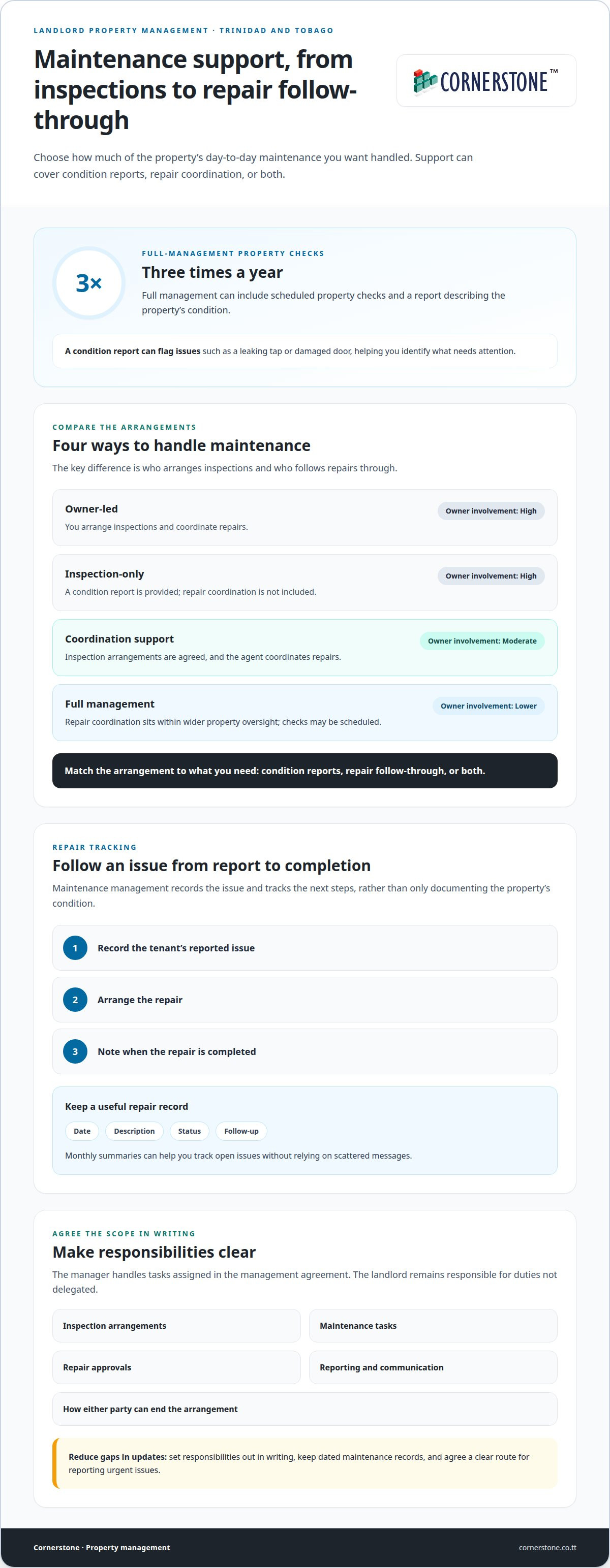
An inspection records a property’s condition, while maintenance addresses issues found during a visit or reported by a tenant. Full management can include property checks three times a year, with a report describing the property’s condition. For example, a report might note a leaking tap or damaged door, helping you identify what needs attention. Inspection-only support offers less coordination than a service that also arranges repairs.
Maintenance Management
Maintenance management follows a tenant’s report through the next steps: recording the issue, arranging a repair, and noting when it is completed. Unlike inspection-only support, it tracks the issue instead of simply documenting the property’s condition. A useful record links each repair to its date, description, status, and any follow-up. Monthly summaries can help you track open issues without relying on scattered messages.
| Option | Inspection | Repair coordination | Owner involvement |
|---|---|---|---|
| Owner-led | Owner arranges | Owner coordinates | High |
| Inspection-only | Condition report | Not included | High |
| Coordination support | As agreed | Agent coordinates | Moderate |
| Full management | May be scheduled | Part of wider oversight | Lower |
Choose based on whether you need condition reports, repair follow-through, or both.
In Trinidad and Tobago, a manager handles the tasks assigned in the management agreement; the landlord remains responsible for duties not delegated. The agreement should clearly set out that division.
A property management agreement should describe inspection arrangements, maintenance tasks, repair approvals, reporting, communication, and how either party can end the arrangement. Clear terms reduce confusion when a tenant reports a fault.
Potential problems include missed repairs, unclear approvals, and gaps in updates. Set out responsibilities in writing, keep dated maintenance records, and establish a clear route for reporting urgent issues.
To change managers or end an agreement, follow its notice and handover terms. Arrange the transfer of inspection reports, open repair records, tenant communications, and property access details.
With full management, the letting agent carries out property checks three times a year and provides a report on the property’s condition as part of the service.
Online rent collection
Rent collection support can include payment records, reminders, follow-up on missed payments, and deposit handling. The scope matters: some services collect rent while you retain other rental duties, while broader management includes collection as part of wider oversight.
A rent collection service may receive monthly payments and follow up when rent is missed. A clear process records the due date, expected amount, date received, and any outstanding balance. If a tenant pays only part of the rent, for example, the record should show both the payment and the amount still owed. This creates a traceable account instead of leaving you to piece together scattered messages.
Online systems can help organize recurring rental invoices and payment reminders. A manager may enter the rental amount and due date, then send an invoice or reminder on the agreed schedule. The system can also record payments against the relevant tenancy. Automation supports routine tracking, but does not replace follow-up when a payment is late or a tenant reports a problem.
Record deposits separately from rent. The record can identify the tenant and property, the amount received, the receipt date, and how the deposit is held. Deposit rules and handling arrangements depend on the agreement and local requirements, so the manager should explain the process in writing rather than treating the deposit as rental income.
Setting rent and collecting it are related but separate tasks. Setting the rent involves considering the property’s location, condition, features, and comparable rental listings. Collection follows the agreed amount and payment schedule. If a manager handles collection, give clear instructions on payment records, late-payment communication, and how updates should reach you.
Compare these arrangements:
- Collection only: The manager records rent payments and follows up on missed payments.
- Invoice support: The manager organizes recurring invoices and reminders alongside payment records.
- Full management: Rent collection sits within broader oversight of the tenancy and property.
Choose the option that matches how much payment follow-up and record keeping you want handled.
Tenant referencing and right-to-rent checks
Tenant screening helps landlords assess applications before agreeing to a tenancy. A manager can organize checks, communicate decisions, and keep application records together. The specific checks and documents depend on the tenancy and applicable requirements in Trinidad and Tobago.
For prospective tenants, referencing may involve reviewing the information they provide and assessing suitability against the property’s requirements. Full management may also involve a referencing agency and checking whether a prospective tenant has the right to rent under applicable legislation. Treat screening results as information to support your decision, not a guarantee of how the tenancy will proceed.
A clear application process can follow practical steps:
- Receive the application and supporting information.
- Review the details and complete agreed background and suitability checks.
- Record the outcome and communicate the next step to the applicant.
- Prepare the tenancy paperwork once the landlord approves the applicant.
Lease management begins after a tenant is selected. A manager can organize the tenancy agreement, share its key terms with the tenant, and retain signed documents. Records should make the rental amount, payment schedule, property responsibilities, and communication route easy to find.
Tenant communication continues throughout the tenancy. A manager may receive a repair report, answer a question about a lease term, or pass an update to the landlord. A clear contact route helps keep maintenance requests and payment concerns from getting lost among unrelated messages.
Evictions require care because the process depends on the relevant law and circumstances. A property manager can keep dated records of notices, communications, and missed obligations, then update the landlord. Any formal action must follow applicable legal requirements; record keeping does not replace legal advice or court procedures.
Compare screening-only support with full management: screening focuses on applications and checks, while full management can extend to lease administration and tenant communication. Choose based on whether you need help only before move-in or throughout the tenancy.
Rental accounting and reporting
Rental bookkeeping turns rent receipts and property expenses into records you can review. A property manager may track rent due, payments received, maintenance invoices, and outstanding balances separately. For example, recording a repair invoice apart from rent income helps a monthly report show what came in and what was spent.
A useful report can summarize rent collected, unpaid amounts, recorded expenses, and open items. This lets you review rental activity without piecing together bank records, receipts, and tenant messages. Agree on the reporting schedule and format in the management agreement, including how supporting documents will be shared.
Rental listing syndication is separate from accounting. It means distributing a rental listing across multiple advertising channels. A manager coordinating listings can keep the advertised rent, property details, and availability consistent. Once a tenant is selected, records should connect the tenancy dates and agreed rent to the correct property account.
Hiring a property manager instead of self-managing shifts routine administration, such as recording payments and preparing reports, to someone else. Self-management leaves you responsible for tracking transactions and following up on missing records. Compare the responsibilities and time involved: consider your schedule, the records you’ll handle, and how much oversight you want.
How do the responsibilities of property management compare with self-management? A manager can handle routine administration, while self-management requires your time for bookkeeping, payment tracking, and reporting. Compare the agreed scope of service with the work you would otherwise handle; either arrangement may suit different landlords.
Choose self-management if you want direct control over records and tenant administration. A letting agent can handle selected rental tasks, while full-service management covers broader responsibilities. Consider how much accounting, tenant communication, and property oversight you want to retain.
Professional property management support can help organize rental records and reporting alongside wider property oversight.
Cornerstone: Property management
Cornerstone offers property management for landlords who want professional help overseeing a rental instead of handling every task themselves. Its management includes prospective tenant screening and background and suitability checks, helping you assess applicants before a tenancy begins. Cornerstone also manages properties in Trinidad and Tobago and handles general administration as part of its management service.
If you need more than management, Cornerstone also handles property rentals, property sales, and property market opinions. A market opinion can inform a property decision, but it is not a licensed valuation. The next step depends on whether you need ongoing management or help with a particular rental or sale.
To discuss managing your rental property, contact Cornerstone.
Choose the level of support that fits your plans
Before deciding, consider how involved you want to be. Think about how you prefer to receive updates, which decisions you want to make yourself, and what would make managing the property more workable. These priorities can guide a clear conversation about the support you need.
Your choice among landlord property management options should reflect your plans for the rental, not just your current workload. Consider whether your involvement might change over time, such as if work or other commitments make regular oversight harder.
You don’t need to settle every detail in advance. Start with the responsibilities you most want help with, then discuss how a management arrangement could address them.
Contact Cornerstone to discuss your options, and take the next step at a pace that feels right for you.
Frequently Asked Questions
What property management options are available to landlords?
Landlords can manage a rental themselves, delegate selected responsibilities, or arrange wider management. Consider how the arrangement should work during a vacancy or if your availability changes. Decide which property decisions you want to retain and how you want to receive updates. These preferences help define an arrangement suited to your circumstances.
What services do full-service property managers provide?
The agreement determines the exact scope, so the label “full service” alone does not explain who makes each decision. Clarify how the manager handles owner approvals, which updates need your attention, and how instructions are recorded. If you want to approve changes to tenancy terms, for example, make that boundary clear from the start. A written scope helps prevent mismatched expectations.
How can landlords find and vet a property manager in Trinidad and Tobago?
Consider whether the manager’s approach suits your property and communication preferences. Decide, for example, whether you prefer updates by email or phone and whether you want a single contact for property matters. Cornerstone’s open communication and data-driven guidance can help you discuss your priorities and understand how its property management service fits your needs. Clear expectations make it easier to get started.